Engineering YARN Optimization for High-Performance Hadoop Clusters
In any mature Hadoop environment, YARN (Yet Another Resource Negotiator) is the central resource manager responsible for scheduling and allocating CPU and memory across distributed jobs. Yet despite its centrality, traditional YARN clusters suffer inefficiencies: container resource allocations are static, based on requested limits rather than actual usage patterns, which leads to under-utilized memory and CPU and, ultimately, wasted capacity and longer job runtimes.
This blog explores how to design a smart optimizer for YARN that continuously observes real utilization, calculates safe over-commitment, and dynamically influences the YARN scheduler to unlock hidden capacity, all based on engineering patterns from the Pulse Yarn Optimizer.
To better understand these optimization concepts in action before diving into the architecture and implementation details, watch the following podcast featuring Ashwin Rajeeva (CTO & Co-founder, Acceldata) and Pallav Kulshreshtha (Senior Director – Engineering, Acceldata), as they unpack one of the most persistent challenges in Hadoop environments, resource wastage in YARN, and explain how Pulse YARN Optimizer uses intelligent resource optimization to unlock hidden cluster capacity and improve workload performance.
Before exploring how a smart optimizer overcomes these challenges, let's examine the root cause of resource inefficiency in traditional YARN clusters and why so much compute capacity remains stranded.
Resource Wastage in YARN
Static Reservation vs. Dynamic Needs
In a typical Hadoop cluster:
- YARN assigns containers based on requested memory and CPU limits from job specifications (e.g., a Spark job requests 8 GB, 2 cores).
- Most of the time, workloads do not use the full allocation; actual utilization often lags behind reserved capacity.
- Even if the physical node has free resources, YARN’s scheduler refuses to allocate additional containers once a queue quota is hit, or reserved capacity is exhausted, leaving valuable CPU and memory idle.
Impact on Cluster Performance
The consequences are tangible while operating at scale:
- Longer job runtimes: Idle memory and CPU slow throughput.
- Cluster imbalance: Some nodes may be overwhelmed while others sit under-utilized.
- Operational costs: More resources must be deployed to meet throughput targets.
- Complex tuning cycles: Engineers resort to guessing static configurations to improve average utilization.
Architectural Principle of Smart YARN Optimization
The core idea behind an optimizer like Pulse’s is to close the gap between reserved capacity and actual usage by applying real-time telemetry and adaptive adjustments.
Components of an Intelligent Optimizer
At a high level, an optimizer consists of:
- Metrics Collector Agents deployed on YARN Node Managers.
- Central Optimizer Service that ingests telemetry, fingerprints workloads, and computes adjustments.
- Communication Pathways to influence the YARN ResourceManager or dashboards for operator visibility.
- Visualization & Control UI to help engineers monitor the effect of optimization.
This architecture mirrors the documented YARN Optimizer Service, Metrics Agent, and UI configuration documented in the Pulse user guide.
System Workflow: From Raw Metrics to Optimized Resources
Below is a simplified workflow diagram of how a Yarn Optimizer system operates:
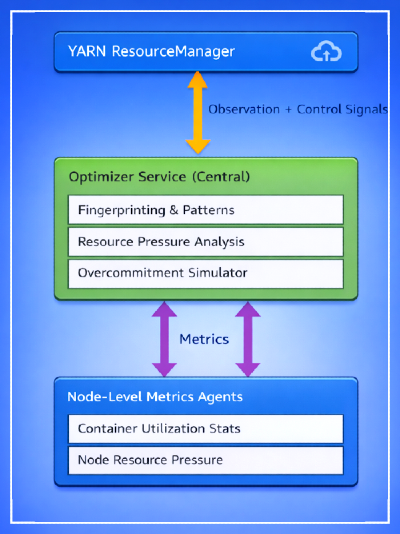
Telemetry: Collecting the Right Signals
An effective optimizer needs rich telemetry on both container and node activity.
Node Metrics
Metrics Agents periodically collect:
- Free/used memory across all Node Managers.
- CPU utilization and per-container CPU usage.
- Pressure indicators such as context switches, I/O load, and network usage.
These signals underpin adaptive decisions about whether nodes are over-committed or under-utilized.
Container Fingerprinting
A fingerprinting mechanism associates resource profiles with specific application types (e.g., Spark vs. Hive):
- Patterns like memory usage distribution over past runs inform safe levels of over-commitment.
- Only containers with trusted historical footprints are included to minimize risk.
This approach reduces noise and ensures the optimizer is making decisions on consistent behavior patterns rather than outliers.
Optimization Logic: Overcommitment and Node Pressure
The optimization engine balances aggressive utilization with safeguards.
Overcommitment Calculation
The central engine computes an effective cluster capacity as:
Effective Capacity = Originally Allocated + Optimized (Overcommitted)
By safely inflating total permissible memory and cores across the cluster, more containers can run without physically adding capacity.
Resource Pressure Scoring
An overall score for node pressure aggregates contributions from CPU, memory, disk, context switches, and network:
Pressure Score = weighted_sum(CPU, Mem, Disk, Context Switches...)
A pressure score above a configured threshold halts further optimization to prevent overload. This is crucial; overcommitment should never harm service stability.
Dynamic Windows & Feedback Loops
The optimizer uses historical time windows and weighted trends:
- Recent activity is weighted higher than long-term averages.
- These sliding windows ensure sensitivity to spikes and sustained behavior.
This prevents reactive oscillations and ensures stable, progressive optimization.
Control Loop Details: What Gets Tuned
Key parameters an engineer can adjust at the optimizer include:
| Setting | Purpose |
|---|---|
| Overutilization Threshold | Percentage that defines when optimization should pause. |
| Underutilization Margin | Minimum unused memory or CPU before optimization triggers. |
| Max Overcommit Multiplier | How far memory/CPU may be safely over-committed (e.g., 1.5×). |
| Node Pressure Weights | Relative importance of CPU vs memory vs network load. |
| Fingerprint Confidence Counts | Minimum historical observations required for decisions. |
These tunables provide risk control knobs over the automatic optimization logic without manual per-job configuration.
Monitoring and Feedback: Visualizing Outcomes
Any optimizer must expose its actions and outcomes so operators can:
- See before/after resource utilization charts.
- Assess memory and CPU distribution over time.
- Track cluster application states: running, pending, completed, failed.
- Track #containers before and after
A typical dashboard will show:
- Original vs. Optimized Memory and vCores
- Allocated vs. Used Containers
- Host-level utilization breakdowns
- Workload health and application trends
This feedback loop is essential to refine tuning and trust optimizer decisions.
Guardrails and Backouts
Intelligent optimization must include safety mechanisms:
- QoS Rules: Pause or revert optimization if nodes breach pressure thresholds.
- Kill Modes: Optionally terminate only containers or whole applications when QoS is violated.
- Overcommit Timeout: Agents can retract overcommit changes automatically if the optimizer central service becomes unreachable.
These guardrails allow automated optimization without jeopardizing cluster stability.
Replication Guide: Key Engineering Steps
If you wanted to build your own YARN optimizer, here’s a condensed engineering checklist:
- Deploy a lightweight metrics collector on each NodeManager that:
- Reports memory, CPU, I/O metrics at configurable intervals.
- Assigns unique container fingerprints for behavior profiling.
- Central optimizer service that:
- Persists and analyzes telemetry (e.g., time series database).
- Computes optimized allocations and target overcommit levels.
- Tracks historical trends with sliding windows.
- Control interface to YARN ResourceManager:
- Executes safe adjustments to resource pool configurations.
- Interfaces via RPC/API to suggest dynamic container limits or incremental capacity.
- Dashboard & UX layer for visualization:
- Time-series trends of original vs. optimized capacities.
- Breakdown of utilization and pressure indicators.
- Configurable thresholds and weights:
- Expose variables for QoS, pressure scoring, and overcommit limits.
- Ensure safety thresholds are adjustable by cluster engineers.
A modern YARN optimizer bridges the gap between reserved capacity and actual utilization through systematic telemetry, adaptive optimization policies, and robust back-pressure controls. By embedding historical patterns and real-time resource pressure into optimization logic, clusters can achieve higher concurrency, faster job runtimes, and better overall infrastructure utilization.
This approach transforms YARN from a static resource allocator into a self-tuning, responsive manager, enabling engineers to squeeze more performance and efficiency from existing hardware.
For an extensive understanding, read 'How We Optimized YARN Clusters Using Intelligent Overcommitment'.
Explore more behind-the-scenes engineering content, design decisions, and practical learnings from large-scale data systems at engineering.acceldata.io, where new technical articles are published regularly.