Scaling Releases Without Losing Control: The Engineering Playbook for Visibility, Security, and Quality
Have you hit a point where shipping fast feels easy—until increasing services, parallel releases, and dependencies start creating bottlenecks, visibility gaps, and higher failure risk?
At Acceldata, this shift became evident as our platform expanded across services, teams, and environments. What once felt manageable started to fragment. Releases multiplied, dependencies deepened, and a basic question—“what’s going live, and how ready is it?” became harder to answer with confidence.
We weren’t facing a single issue, but a pattern of systemic challenges:
- Too many releases to manage With multiple services evolving in parallel and continuous delivery in motion, releases were no longer linear. Tracking what was going where, and in what state, became increasingly opaque, reducing visibility and slowing decision-making.
- A rapidly growing vulnerability surface Security scans surfaced a high volume of vulnerabilities across code and containers. Detection wasn’t the problem, prioritization was. Ensuring critical issues were resolved before release, without blocking velocity, became a constant challenge.
- Inconsistent quality signals across teams Test coverage and validation standards varied significantly between teams. This lack of uniformity meant “release-ready” wasn’t consistently defined, creating uncertainty and increasing the risk of defects reaching production.
- Manual promotions that didn’t scale Advancing releases across environments still relied heavily on manual steps. This introduced delays, increased the likelihood of human error, and made traceability and auditability harder than necessary.
Why Release Governance Matters
As systems grow in scale and complexity, the risks associated with releases also increase. Security vulnerabilities, insufficient testing, configuration drift, and lack of deployment visibility can all slow teams down or introduce production issues. Strong release governance solves this by creating automated checks and transparent controls without becoming a bottleneck.
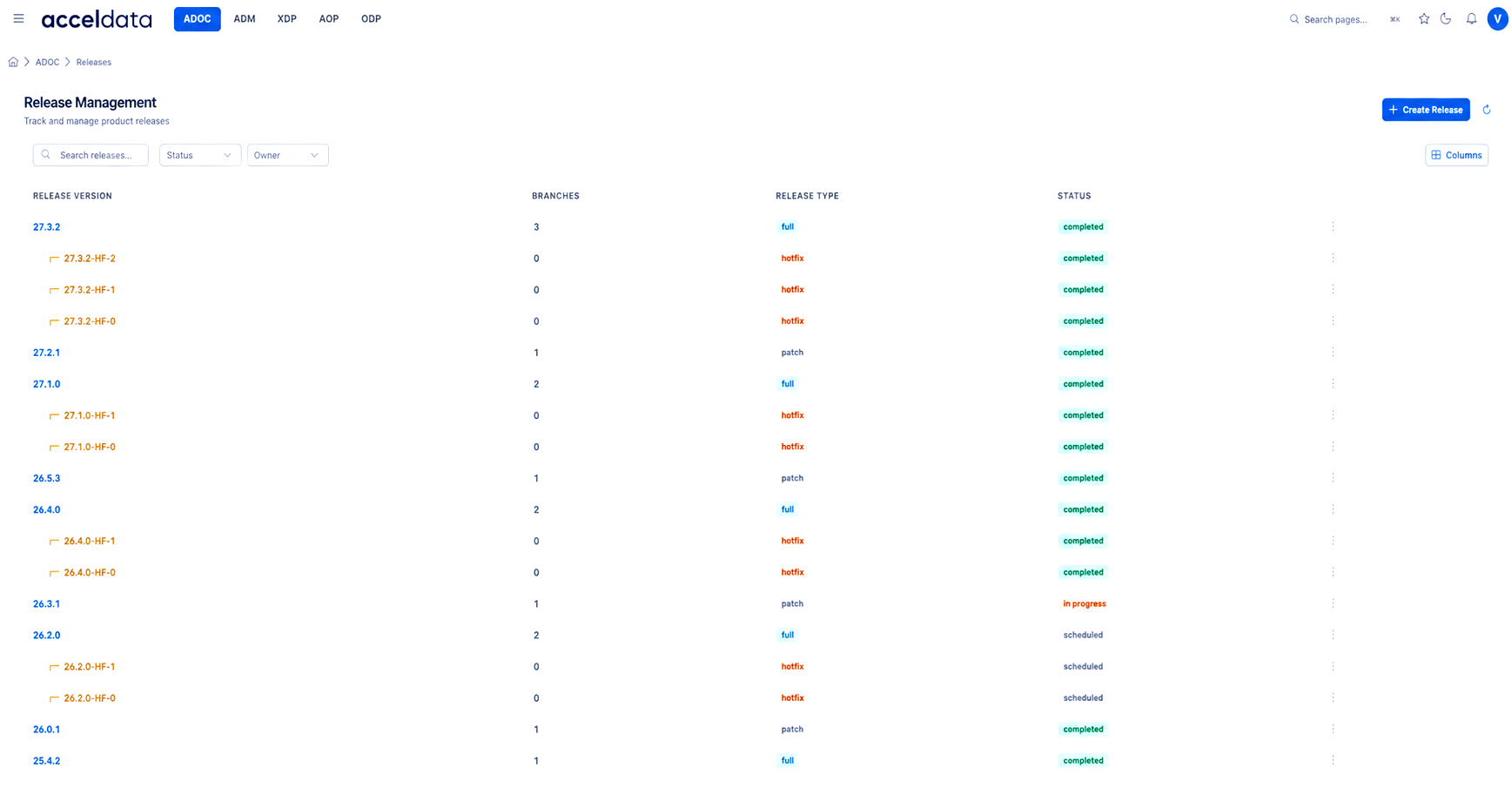
Take a look at the Release Management Dashboard below, designed to efficiently manage and monitor all releases and hotfixes.
Shift-Left with Automated Guardrails
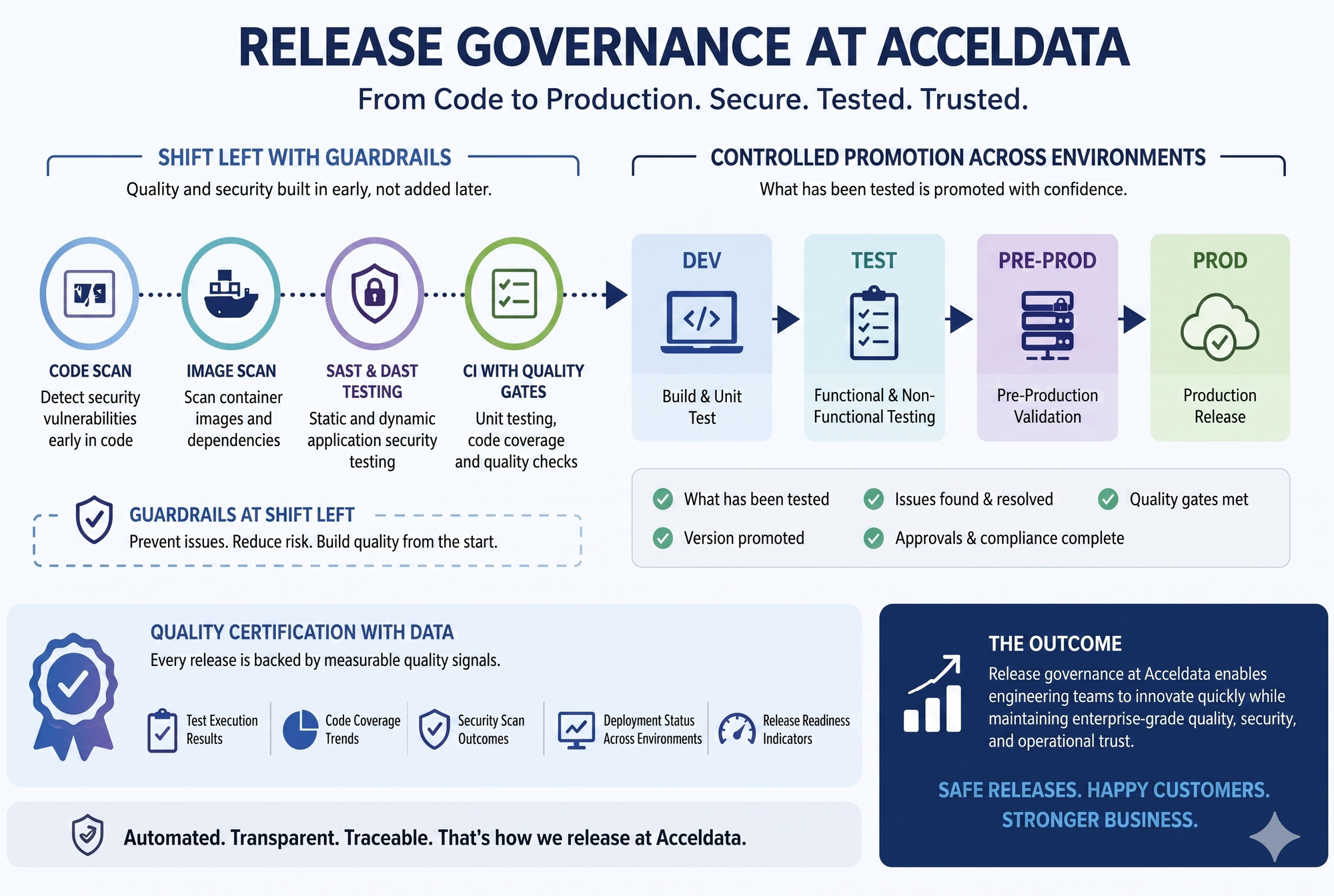
At Acceldata, quality begins early in the development process. We apply a shift-left approach by integrating governance directly into developer workflows and CI pipelines.
Before code can progress, it passes through automated controls such as:
- Code security scans to detect vulnerabilities early
- Container image scans to validate dependencies and runtime security
- SAST and DAST testing for secure application development and runtime validation
- Unit tests and CI quality gates
- Code coverage checks to maintain engineering standards
By catching issues earlier, teams reduce rework, improve developer productivity, and accelerate delivery.
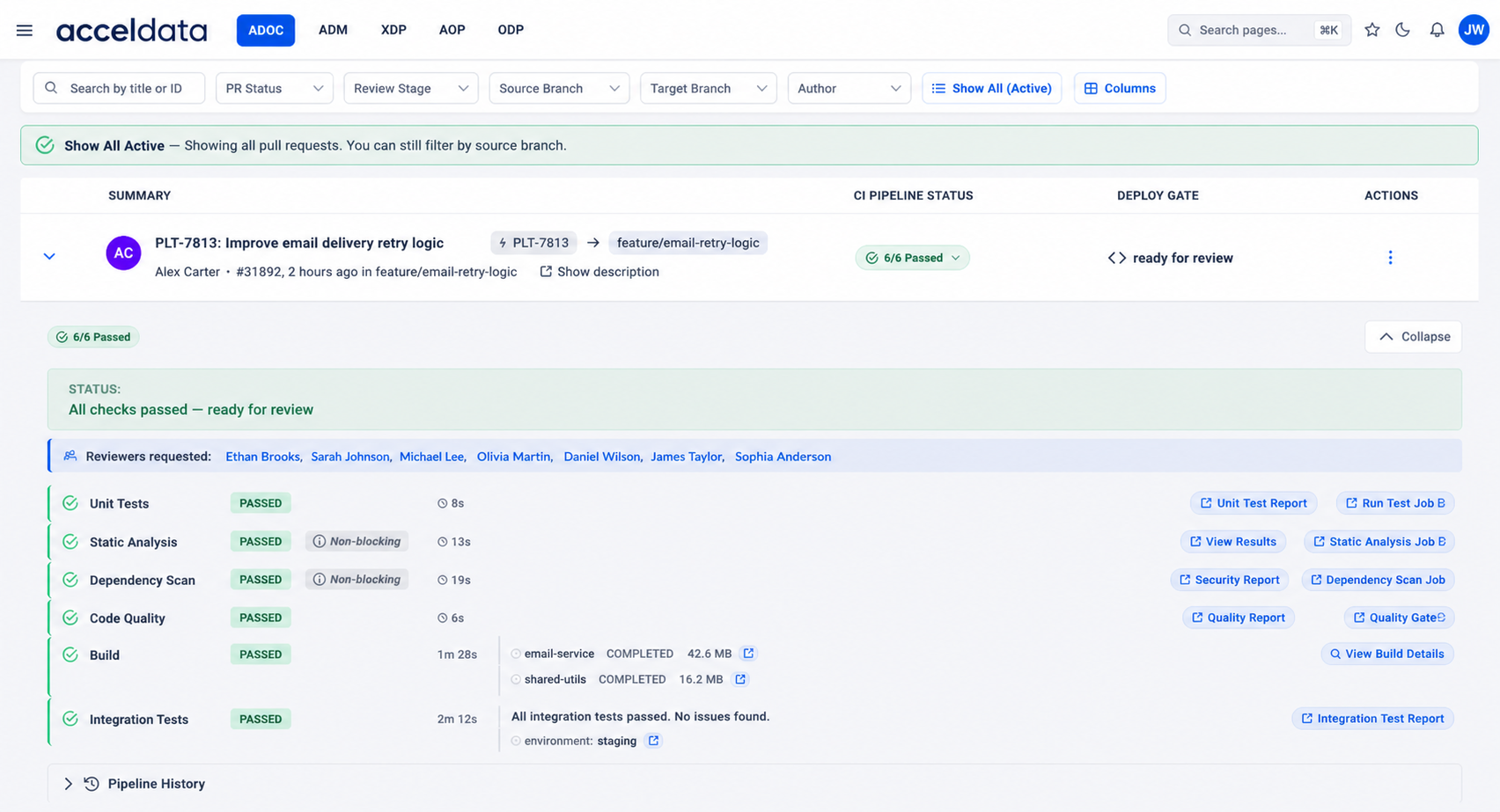
Here, take a closer view of the CI dashboard, which provides real-time visibility into build pipelines, automated validations, and quality gate outcomes.
Controlled Promotion Across Environments
Every build artifact promoted across environments carries its testing evidence and release history. Promotions happen through a structured path:
Development → Test → Pre-Production → Production
At each stage, governance provides clear answers:
- What has been tested?
- Which version is being promoted?
- Were all quality gates passed?
- Were issues identified and resolved?
- Are approvals and compliance checks complete?
This creates confidence and traceability at every step of the release process.
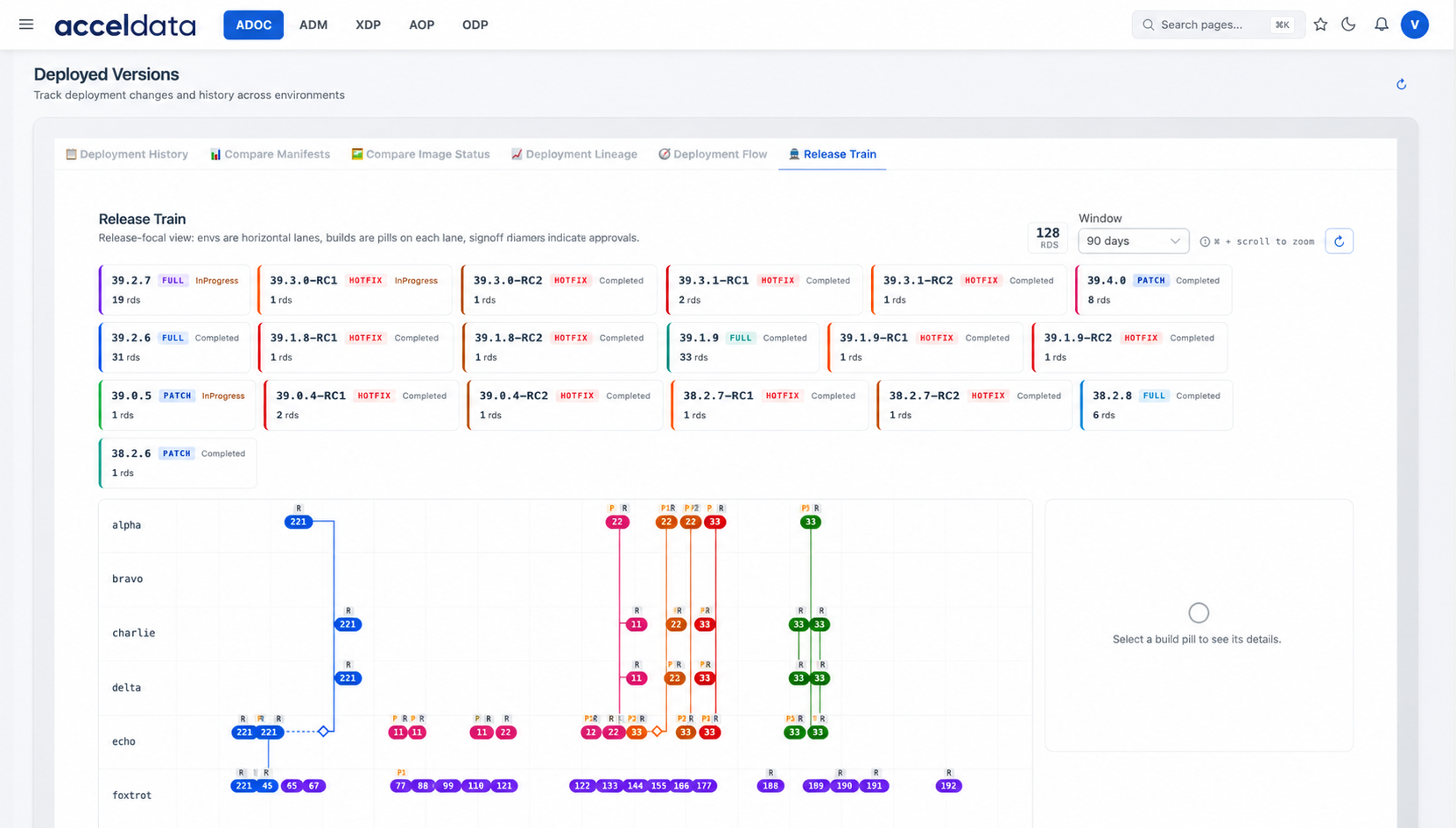
You can take a look at the release train dashboard below, which provides a consolidated view of release progression, dependencies, and deployment status across environments.
Quality Certification with Data
Release decisions should not rely on assumptions. At Acceldata, we use data-driven quality certification to evaluate release readiness.
Each release is backed by metrics such as:
- Test execution results
- Code coverage trends
- Security scan findings
- Deployment success across environments
- Release readiness indicators
- Historical quality signals and trends
This allows teams to make faster, smarter, and more reliable release decisions.
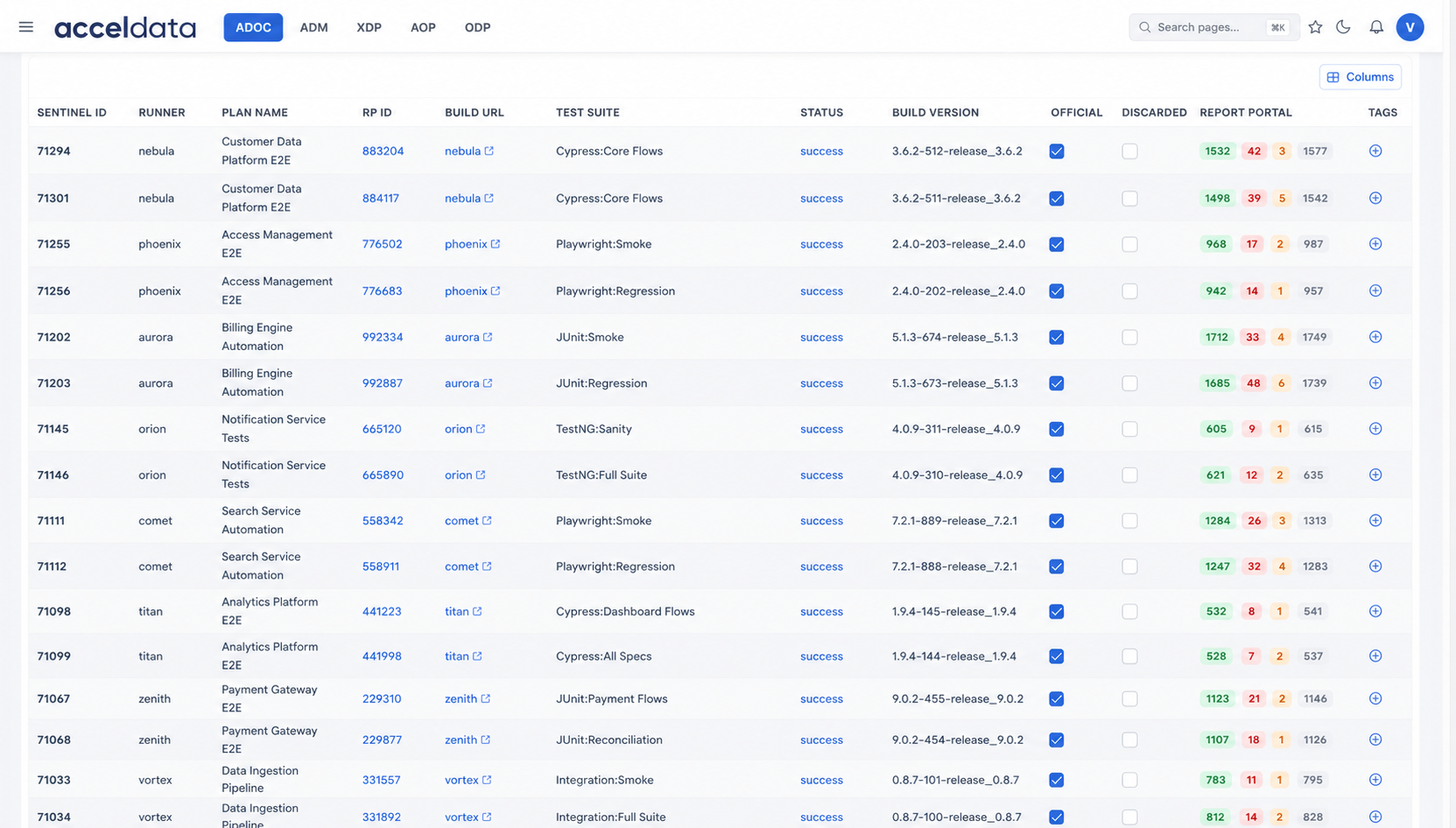
Here, you can take a look at the Quality Engineering dashboard below, which highlights key metrics on test coverage, execution results, and overall release readiness.
Below is the end-to-end Release Governance framework at Acceldata, illustrating how quality, security, and control are embedded across every stage of the release lifecycle. It brings together shift-left practices, automated validations, and structured promotions to ensure every release is reliable, traceable, and production-ready.
Business Impact
Modern release governance is not about slowing innovation — it is about enabling it responsibly. By combining automation, security, quality controls, and deployment visibility, Acceldata helps engineering teams ship faster while maintaining enterprise-grade trust and reliability.
Release governance at Acceldata transforms software delivery from a manual risk process into an automated, transparent, and scalable operating model. It ensures that every release is not only faster — but better.