How to Build Reliable Voice Agents that Won't Break : From Demos to Production
What Was the Problem We Wanted to Address
Voice AI is usually described as an AI system that can speak and listen. That definition is technically correct. But it misses the real problem. At SuperBryn, we define voice AI less as a "talking bot" and more as a real-time decision system operating inside a human conversation. That distinction matters because the failure modes are completely different from text-based AI.
A production voice agent is a chain of many components: telephony, ASR, LLM, tool-calling, policy logic, state management, TTS, latency budgets, and observability. A weakness in any one layer can break the entire experience - and the break often isn't loud. The agent doesn't crash. It just sounds slightly wrong, or routes to a human it shouldn't, or marks a task complete when it wasn't.
The capability side is already obvious. Voice agents can answer calls, schedule appointments, qualify leads, collect information, handle support queries, and update business systems.
But capability is not the same as dependability.
A demo can work beautifully for five calls. A production voice agent has to survive thousands of calls with users who interrupt, mumble, hesitate, change their mind, ask policy-sensitive questions, speak in different accents, and behave nothing like the test script.
The problem we wanted to solve: how do you make that survivable, and how do you measure it?
What Was Failing
Voice-agent testing today falls into two camps, and both break in production.
The first is manual testing. A product manager calls the agent. QA tries a few flows. Customer-success teams report failures from real conversations. Engineers inspect transcripts after something breaks.
This works when the agent is simple. It breaks when the agent becomes important.
A production voice agent can fail because of ASR errors, misunderstood intent, broken dialogue state, failed tool calls, latency spikes, interruption handling, policy violations, poor escalation, or unnatural conversation flow. Manual testing cannot cover that surface area consistently.
The second camp is teams that already know they need a testing platform - but the tooling landscape is fragmented. Some platforms focus on simulation. Some on transcripts. Some on analytics. Some on observability. Some on prompt evaluation. Teams end up stitching together tools, scripts, dashboards, spreadsheets, and human review.
Even with platforms, the process still requires too much hand-holding. Someone has to define scenarios. Someone has to decide what success means. Someone has to write meaningful edge cases. Someone has to interpret failures and route them to engineering, product, QA, compliance, or operations.
That is hard because voice-agent testing is naturally cross-functional. A product manager may know the customer journey but not the technical failure modes. An engineer may know the architecture but not the compliance edge cases. QA may know test coverage but not the business context.
Testing becomes a coordination problem. Too many stakeholders are needed to answer one question: Is this agent ready for production?
Because that answer is hard to produce, production timelines stretch. Launches get delayed. Changes create uncertainty. Bugs are discovered late.
There is also a subtler failure mode: a bad voice agent does not always fail loudly.
Sometimes it fails politely. It apologizes. It repeats itself. It asks the same question twice. It routes the user to a human without explaining why. It marks a task complete even though the user's actual goal was not achieved.
Most teams test whether the happy path works. Production tests whether the unhappy path survives.
What Success Means in the Long Term
The unlock was treating voice-agent evaluation not as a QA checklist but as a structured reliability framework - and separating failure types instead of collapsing them into a single pass/fail judgment.
We defined success across five distinct layers:
- Conversational success - Did the agent understand intent, maintain context, and recover when the user changed direction?
- Task success - Did the agent complete the actual job? Did it book the appointment, update the CRM, verify the customer, resolve the ticket?
- Policy success - Did the agent follow business rules? In BFSI, healthcare, and lending, compliance, consent, and disclosures are not optional.
- Experience success - Did the interaction feel natural? Was latency acceptable? Did the agent avoid awkward silences and unnecessary repetition?
- Recovery success - When something went wrong, did the agent degrade gracefully? Did it clarify, retry, escalate, or safely exit?
Recovery is the most overlooked category. It is also where production separates from demo.
Once you have that taxonomy, you can stop asking "did the agent work?" and start asking "which failure class is this, and who owns it?"
Architecture: The Ring System
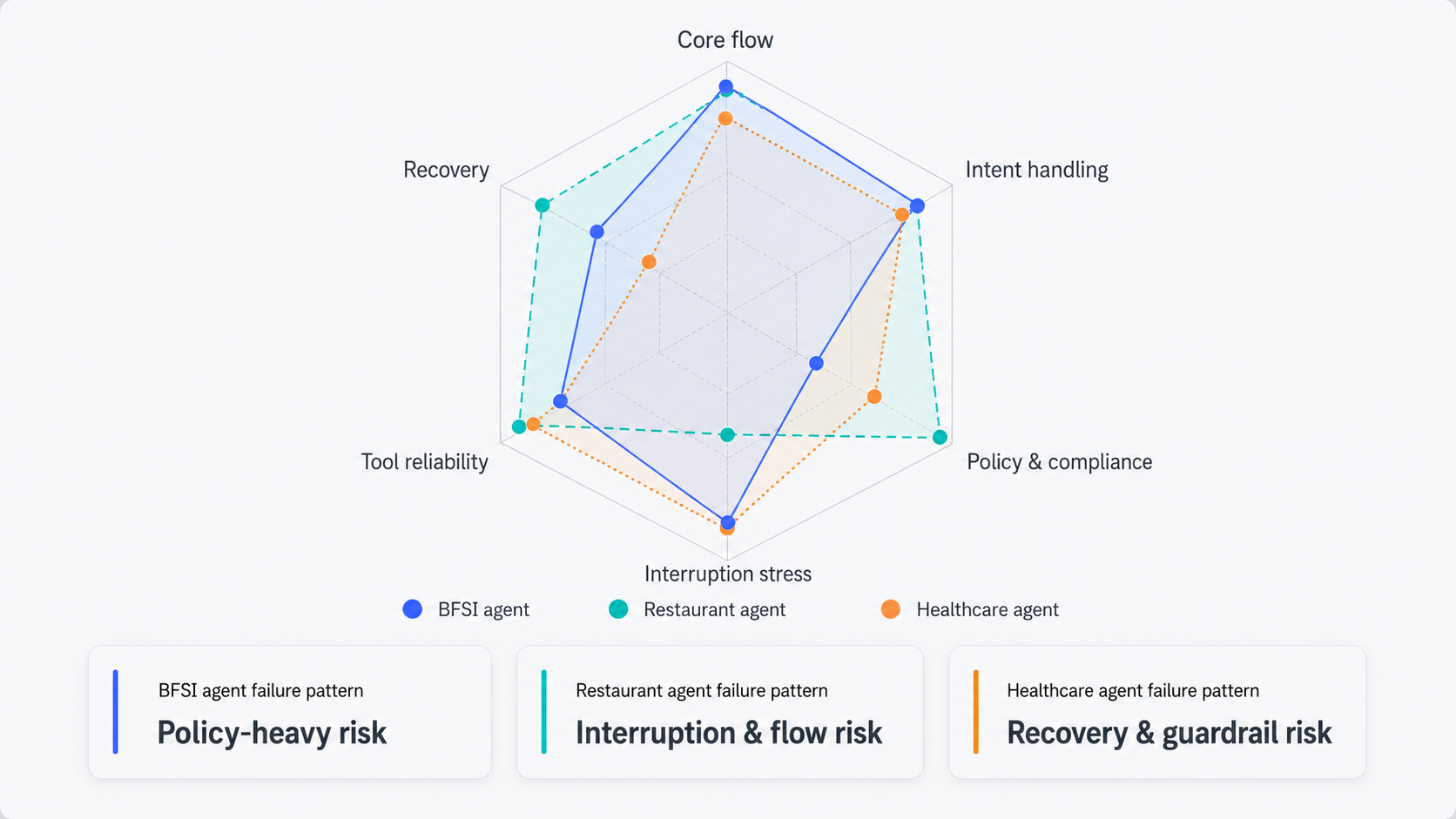
SuperBryn's evaluation framework is built around a concept we call the Ring System - a layered approach to classifying voice agent failures before they reach production.
The mental model is close to how engineering teams already think about incident severity. P0–P3 frameworks exist not because the thresholds are magic, but because classification changes how you respond. A P0 wakes up engineering at 2am. A P3 goes in the backlog. The same bug, categorized differently, produces completely different outcomes - different owners, different urgency, different fix.
Voice agent failures need the same treatment. A policy violation in a BFSI escalation flow is a P0. A slightly awkward pause in a restaurant booking agent is a P3. Treating them the same is how teams end up with the wrong people in the room.
The Ring System applies that logic to evaluation. Not a single pass/fail gate, but a layered structure that separates foundational reliability from stress behavior, from policy adherence, from latency, from edge cases. Each layer runs independently. Failures map to a class. The class tells you who owns it and how urgently.
It does two things.
First, it compresses evaluation time. Instead of relying on multiple people across product, QA, engineering, and operations to manually discover failures, scenarios are organized by failure class, run systematically, and mapped back to a specific layer. Every change gets tested against the same structure.
Second, it gives every stakeholder a shared language for failure. Instead of "the agent is bad," a team can say: "The agent passes Ring 1 and Ring 2, but fails Ring 3 and fails Ring 4 when interrupted mid-verification." That tells engineering where to look, tells leadership what risk remains, and tells QA what to retest.
Different agents need different emphasis. A restaurant reservation agent lives or dies on interruption handling and flow completion. A debt-collection agent needs policy, consent, and escalation weighted heavily. A healthcare intake agent needs guardrails and safe handoff. The Ring System adjusts - same framework, different weights.
An Engineer's View: Where Voice Agents Actually Break in Production
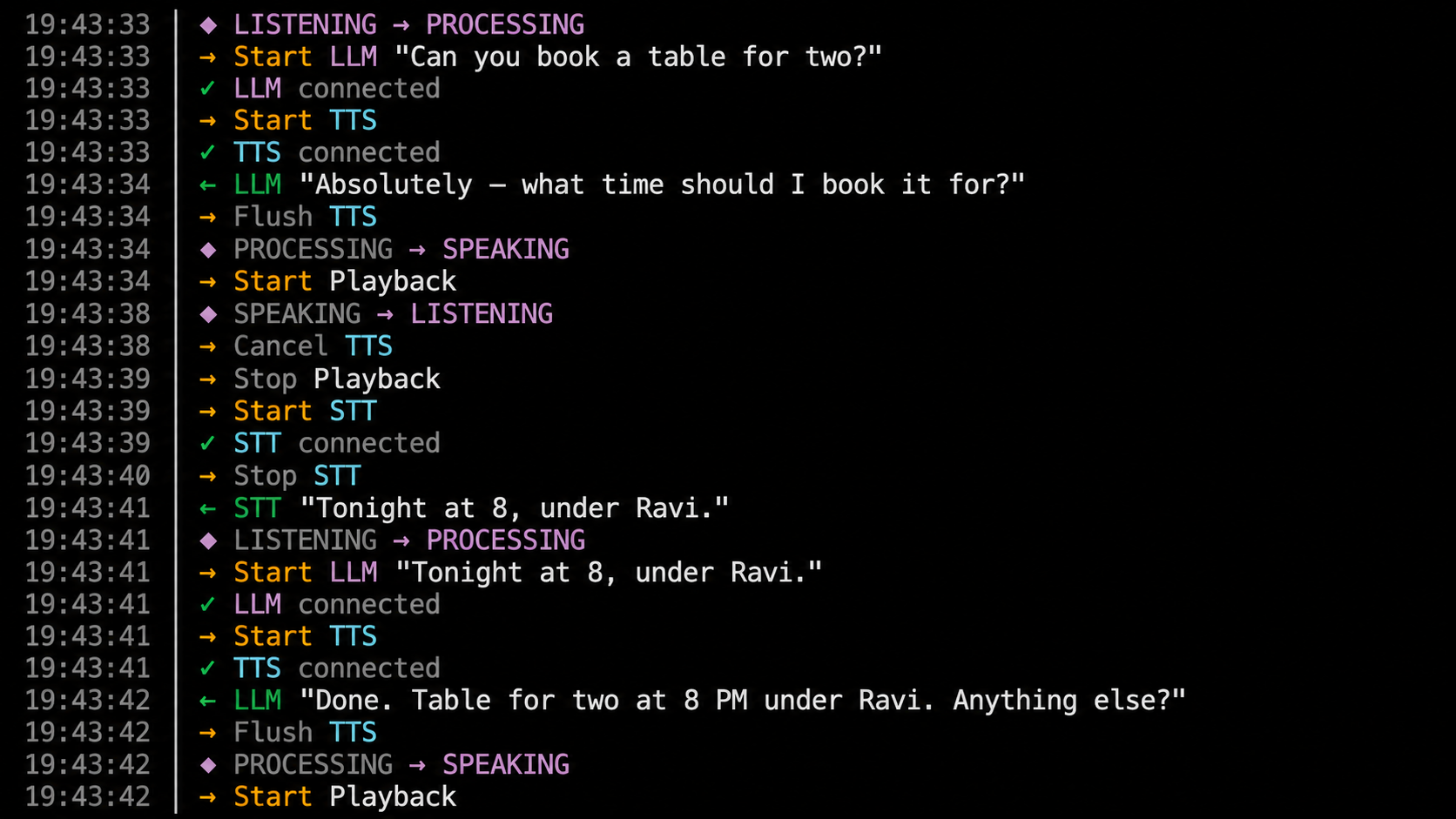
If you've shipped a voice agent, you already know that the component-level failures are where the real work lives. This section discusses the wall, you’ll run into while building voice agents
- Voice is an orchestration problem, not a model problem.
The most common mistake engineers make when moving from text agents to voice is treating the pipeline as sequential: STT → LLM → TTS. That mental model is wrong for production. Every step needs to be streaming, and the streams need to be coordinated in real time. The moment you wait for a full LLM response before sending to TTS, you've already lost 400–800ms that users will feel.
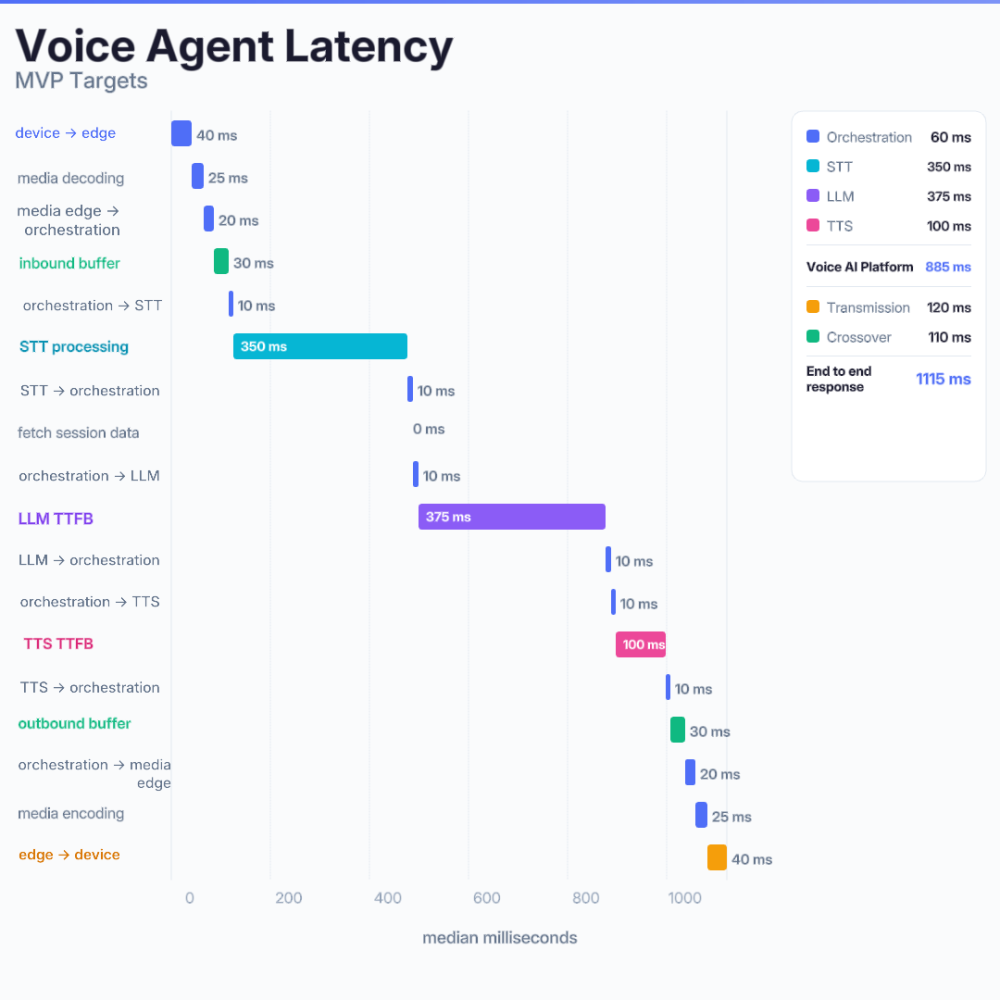
The real-time loop looks like this: audio frames come in from telephony (typically 20ms μ-law packets from Twilio), get fed to a VAD model to detect speech, then pass to STT for transcription. When the turn ends, LLM generation starts immediately and tokens stream directly into TTS. TTS audio frames go back out to the caller as they're produced. Nothing waits for anything to finish.
- Turn detection is harder than it looks.
VAD tells you whether someone is speaking. It does not tell you whether they're done. A slow speaker pauses mid-sentence. A thoughtful pause is not an end-of-turn signal. Pure VAD will start talking too early and consistently feel rude.
Production turn detection combines VAD with semantic signals from the partial transcript - the system needs to infer from content whether a pause is mid-thought or end-of-turn. Services like Deepgram's Flux handle this in a single streaming API, emitting start-of-turn and end-of-turn events with the transcript included. For teams building their own orchestration, this is the hardest primitive to get right, and it's also the one most responsible for whether a conversation feels natural.
- Barge-in is a cancellation cascade, not a pause.
When a user starts speaking mid-response, the system must immediately cancel LLM generation, tear down the TTS connection, and flush all buffered outbound audio simultaneously. If any one of those steps lags, barge-in feels broken. The audio keeps playing for a beat after the user starts talking, which destroys the sense of a real conversation. This has to propagate to every layer at once - it's not a sequential teardown.
- TTFT is the latency metric that actually matters in voice.
Most provider benchmarks report inference time. That's not what users experience. The number that matters is time-to-first-audio: from the moment the user stops speaking to the moment they hear the first syllable back. That path runs through endpointing delay, STT latency, TTFT from the LLM, TTS synthesis startup, and network hops between all of them.
In practice, TTFT from the LLM accounts for more than half the total. Groq's inference for models like llama-3.3-70b averages around 80ms TTFT. GPT-4o-mini is closer to 300-400ms. At voice speeds, that gap is the difference between a conversation that feels snappy and one that feels hesitant. Model selection is not just a quality decision - it's a latency decision.
- Geography is a first-class design parameter.
If your orchestration layer, STT provider, TTS provider, and telephony edge are not co-located, latency compounds across every hop. Moving orchestration to the same region as your STT and TTS endpoints can cut end-to-end latency in half with no other changes. This is not an optimization pass - it should be in the initial architecture.
- Keep TTS connections warm.
Opening a fresh WebSocket to a TTS provider on every turn adds 200–400ms before the first audio byte. A small pool of pre-connected sockets eliminates this. It's one of the highest-ROI reliability improvements you can make for under an hour of engineering time.
- This is where the Ring System connects to the engineering layer.
Specific Ring levels are directly testing the orchestration behaviors above. One ring level’s failures map to barge-in cancellation issues - audio continuing after the user speaks, or the agent not recovering cleanly. Another ring level failures map to TTFT budget overruns, geography mismatches, or TTS cold-start delays.
When an agent fails the Ring in evaluation, the debugging question becomes: is the cancellation cascade incomplete? Is there a TTS buffer not being flushed? Is the VAD model triggering too slowly?
That's a much more useful starting point than "the conversation felt off."
Theory to Conversion
This is how the Ring System changes the actual development workflow.
Without structured evaluation: Teams test a few obvious calls. Failures are discovered late. Bugs are reported inconsistently. Engineers struggle to reproduce issues. Every prompt change creates anxiety because there's no regression baseline.
With structured evaluation: Scenarios are organized by failure class. Evaluation runs automatically on every change. Failures map to specific rings, which map to specific system layers. Teams know whether a problem is conversational, policy-related, latency-related, tool-related, or domain-specific. Regression testing becomes part of the development loop, not a pre-launch panic.
The practical unlock: when a prompt change causes a particular ring regression, you know immediately what shifted- not that "the agent got worse somehow." You can bisect the change instead of re-testing every flow from scratch.
What Mistakes Not to Make
- Grouping all failures together. A policy failure is not the same as an ASR failure. A latency failure is not the same as a bad prompt. A tool failure is not the same as poor conversation design. If all failures get routed to the same queue, debugging becomes slow and ownership gets muddy.
- Testing only the happy path. In the real world, users will interrupt. APIs will fail. Users will ask vague questions, change their mind, provide partial information. If your agent is only tested on the ideal path, production becomes the real test suite - and you find out on a live call. The unhappy path - partial information, mid-call API failures, users who refuse to follow the flow - is where agents fail in production and where users lose trust permanently.
- Treating evaluation as a pre-launch exercise. Every change to a prompt, model, workflow, or tool can introduce regressions. A model upgrade that improves quality on your benchmark can silently increase TTFT by 200ms. Evaluation needs to be continuous.
- Using a generic benchmark. A BFSI voice agent, a healthcare agent, a restaurant agent, and a logistics agent have different failure modes and different risk tolerances. A benchmark that doesn't understand the business context is measuring the wrong things.
- Testing transcripts only. Transcripts hide the audio-native failures. ASR errors, endpointing misfires, TTS pronunciation gaps, and barge-in timing issues only surface when you evaluate the actual audio experience, not just the text output.
You can listen to a detailed conversation below, where Ashwin Rajeeva and SuperBryn CEO Nikkitha Shanker unpack why production-grade voice AI is an orchestration challenge, not a model one, exploring turn detection, barge-in, and time-to-first-audio as the metric that really defines user experience.
They also dive into SuperBryn's Ring System, a framework for classifying voice agent failures, and why reliability frameworks and continuous evaluation are what separate demo-ready agents from real, trustworthy infrastructure.
Voice AI will not become mainstream just because models improve. Better models will help. Lower latency infrastructure will help. More natural voices will help. But the real unlock is trust.
Businesses need to trust that agents will behave correctly. Developers need to trust that changes will not silently break production. Users need to trust that the agent can understand them, help them, and recover when things go wrong.
That trust comes from reliability systems - not from better demos.
Software engineering became more reliable when testing, observability, CI/CD, and incident management became standard practice. Data engineering became more reliable when teams started treating data quality, lineage, and monitoring as first-class concerns.
Voice AI needs the same evolution.
SuperBryn's bet is that the field needs a structured way to evaluate, observe, and improve agents before users discover the failures themselves. The Ring System is one approach to that: a way to compress evaluation time, standardize failure analysis, and make reliability measurable across the full stack - from business policy down to TTS connection pooling.
Because the future of voice AI will not be won by the agent that sounds the most impressive in a demo.
It will be won by the agent that still works on the thousandth messy, interrupted, unpredictable production call.
That is when voice AI becomes infrastructure.
To stay updated on the latest developments in Voice AI and follow the entrepreneurial journeys of the minds behind Superbryn, connect with Nikkitha Shanker and Neethu Mariam Joy on LinkedIn.
If you're into hands-on build breakdowns, system design walkthroughs, and firsthand takeaways from teams shipping production infrastructure, follow engineering.acceldata.io and get fresh posts delivered every week.